Notebook · Brookline
Viking vs Wolf Ranges: What Actually Differs When One Breaks
Compared at the showroom the two look interchangeable. Compared with the front panel off, three things separate them: how the burner is built, whether the oven runs on gas or electricity, and whether the parts for your production run are still to be had.
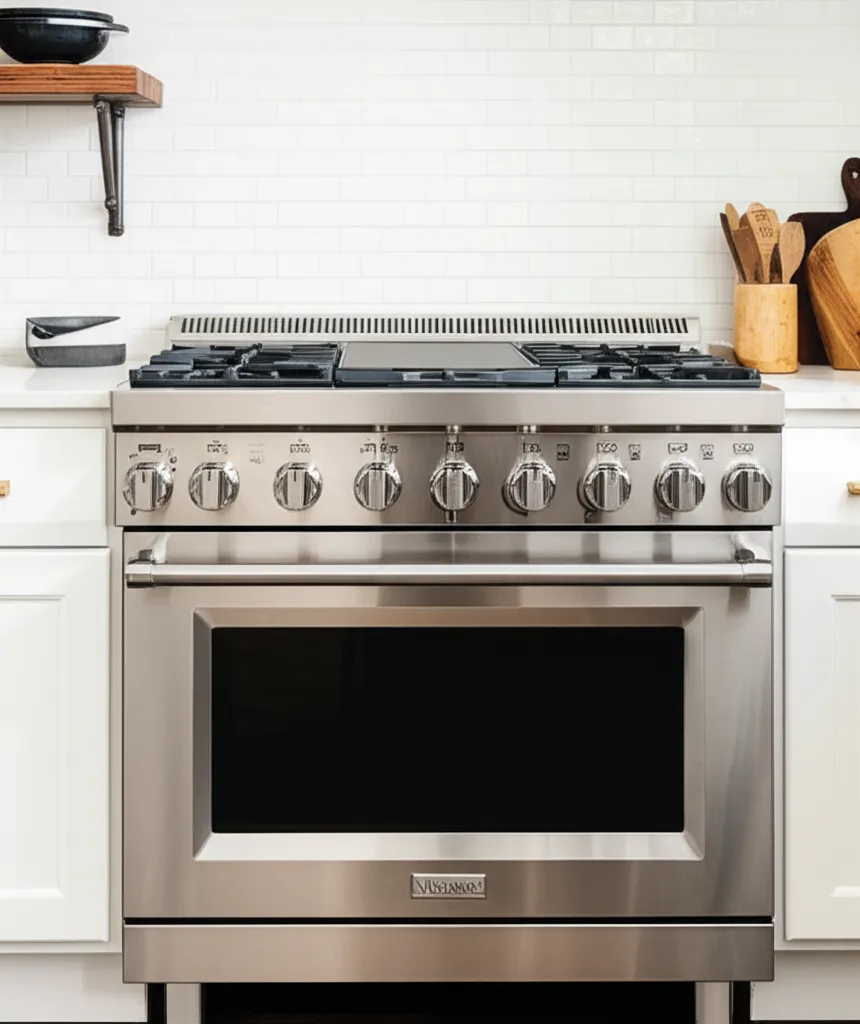
Pick between them on the burner design and the oven configuration, because those are the two choices you cannot change later. Once the front panel is off, a Viking and a Wolf of the same era fail in broadly the same places — ignition, oven heat, a door that no longer seals — and what genuinely separates them is how the burner is put together, whether the oven is gas or electric, and how well supported your particular production run still is.
That is not how the comparison is usually written. Most of it is fought over output ratings, cavity volume and the finish on the handles, and none of those decide anything in year twelve. What follows is the version that matters once the range is installed and has been used hard.
The burner is where the two makes are genuinely unalike
Wolf’s sealed burner is dual-stacked: two tiers of ports on one burner, the upper for heat and the lower for a flame low enough to hold a sauce. It works, and it changes the fault pattern. A boil-over blocks the small lower ports first, so the complaint arrives as a burner that roars perfectly on high and refuses to stay alight on low. Owners read that as a gas problem. It is usually a cleaning problem in a place that is hard to see.
Viking’s sealed burners take a single port ring down to a simmer setting instead. Fewer small openings to block, so a low flame that has become unreliable points somewhere else — pressure at the appliance, a cap sitting fractionally off its seat, or a ring that has corroded unevenly. On the older open-burner Vikings the geometry is different again: the burner sits over a well that collects everything the pan spills, and the electrode lives down in it. Those units need the well cleaned out, not the burner cleaned off.
What the two share is the ignition circuit. One damp electrode makes the whole set tick, because the module sparks every position until it sees a flame somewhere. Dry it out, seat the caps square, clear the ports with something that will not widen them. If the ticking outlives that, the ceramic on an electrode has probably cracked and is dumping its spark into the pan support.
Gas oven or dual fuel decides more than the badge does
Both makes sell both configurations, which means a Wolf dual-fuel has far more in common with a Viking dual-fuel than with a Wolf all-gas range. This is the fork in the road, and people rarely notice they took it.
An all-gas oven lights through a glow-bar igniter. The bar draws current, gets hot, and that current draw is what pulls the safety valve open — the glow is a side effect, not the mechanism. As the bar ages it still glows convincingly while drawing too little to open the valve, so the oven takes longer and longer to light and then one day does not. That is why “it glows, so the igniter is fine” is the most common wrong conclusion on a gas range, and why the measurement is amps rather than eyesight.
A dual-fuel oven has no igniter to age. It has bake and broil elements, a temperature sensor, one or more convection motors and a control board, and it fails as drift rather than as a refusal: everything browning unevenly, a cavity reading consistently under its setting, a fan that has started to rattle. A sensor can be measured in ohms cold before anything is ordered, which is worth insisting on — a drifting sensor and a tired element produce similar complaints and very different bills.
Model year outranks the manufacturer
Both lines revised burners, control boards, sensors and fan assemblies repeatedly across their production. The consequence is practical: the serial plate, not the model name, decides which part fits. On these ranges the plate is usually on the frame behind the oven door or behind the lower kick panel, and photographing it takes ten seconds.
The same fact governs downtime, which is the part of a repair people actually feel. Caps, electrodes, igniters, elements and thermostats are ordinary stock and rarely hold anything up. Control boards, hinge assemblies and door glass for a run that ended years ago are the ones that turn a repair into a wait, and occasionally into a dead end. If you are looking at a used pro range, that is the question to ask first, and it is a better question than the price.
Self-clean is the hardest hour either oven ever works
Neither make is meaningfully better at surviving a pyrolytic cycle. The oven deliberately runs far above cooking temperature with the door locked, and the components nearest that heat — the latch mechanism, a thermal cut-out, the board that watches both — are the ones that give up afterwards. The classic sequence is an oven that worked fine, was cleaned, and was dead the following morning.
The way to keep it out of the schedule is dull but effective. Run the cycle when you are in the house and not the day before you need the oven, and do not run it at all on a range already showing a temperature offset, because whatever is causing the offset is about to be asked to work at its limit.
The other slow leak is the door. A pro range door is heavy, its hinges are spring loaded, and as those springs relax the door rests fractionally proud at the top. Nothing looks wrong. The cavity simply bleeds heat all afternoon, roasting is off, and it gets blamed on calibration for a year before somebody puts a hand along the top edge while the oven is up to temperature.
What this looks like in a Brookline kitchen specifically
These ranges usually go into rooms that were never planned around them. A galley in a Beacon Street apartment or a rebuilt kitchen in a frame house off Walnut Street gives you a heavy appliance wedged between cabinets, on a floor that may not enjoy being slid across, connected with a flexible line that has to be treated properly on the way out and the anti-tip bracket refitted on the way back. Pulling one is a two-person job and not a spontaneous one.
Two things are worth flagging because they are not repair questions at all. If you smell gas, leave and call the gas utility from outside — that is ahead of any appliance conversation. And if a long bake in a closed kitchen with a downdraft running produces fumes, the room is fighting the appliance for air, which is a ventilation matter for a gas fitter rather than something to be adjusted at the range.
Before you call anyone, write down four things
The make and the serial from the plate. Whether the oven is gas or dual fuel, since half the diagnosis follows from that. Which specific burner or which oven function is misbehaving, and how it misbehaves rather than the word “broken”. And what changed just before it started — a boil-over, a self-clean cycle, a power cut, a shut-off valve someone touched. That list turns a vague call into a booked part.
One boundary, plainly: this shop is refrigeration. Built-in columns, freezers, ice makers and wine cabinets are the week’s work, and a professional range wants somebody who spends their days on cooking appliances. Our Wolf and Viking pages exist for the same reason this one does — the question deserved an answer rather than a redirect.
If it is the cold half of the kitchen that has gone wrong, that is us. Sub-Zero Repair Brookline covers Brookline, the South End, Jamaica Plain and Back Bay; a visit opens with the flat $95 service call, and refrigerator repair sets out what that covers. Ring (617) 340-2816 with the model number to hand.
Still asked afterwards
Is a dual-fuel range harder to repair than an all-gas one?
Not harder, but the failures land in different places and one of them is more expensive. An all-gas oven concentrates its faults in the igniter and the safety valve, and both are catalogued mechanical parts. A dual-fuel oven adds elements, a temperature sensor, a convection motor and a control board, so there is more that can drift and one component — the board — that costs more than the rest put together. Against that, the electric cavity holds a steadier temperature, which is the reason people buy it. Neither configuration is a mistake; they simply hand you a different list.
My range is twenty years old. Can parts still be had for it?
Sometimes, and the honest answer is that it depends on the exact production run rather than on the make or the decade. Burner caps, electrodes, igniters and elements tend to stay available or have a workable equivalent. Control boards, door glass and hinge assemblies for a discontinued run are the ones that stall a repair, occasionally permanently. Anybody quoting a job on an older pro range should be establishing availability before they start, not after the old part is out.
Why would a range matter to the refrigerator standing next to it?
Because in a galley kitchen they share air. A pro range throws real heat into the room, and a built-in refrigeration column rejects its own heat through a condenser breathing at floor level a few feet away. Cook heavily in a small closed kitchen and that column runs longer cycles than it was designed around. It is not a fault and it does not damage anything on its own, but it does explain why a fridge that behaved for years starts running hot in a kitchen that has just gained a serious cooker.